



Margherita Maria del Cuore Eucaristico di Gesù
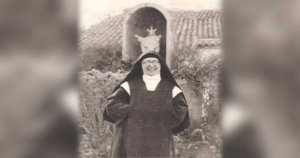
Margaret Mary was born in Cocentaina, diocese of Valencia (Spain) on March 16, 1908 and was baptized on the 25th of that month in the parish of Santa María. At the age of 8 she made her first communion. At the age of 12 she entered the Sisters of the Purity of Mary school in the city of Ontinyent, remaining six years as an intern. In 1934, at the age of 26, she entered the convent of the Discalced Carmelite nuns in Manises, where she made her simple vows on January 9, 1936, taking the name of Margaret Mary of the Eucharistic Heart of Jesus.
When religious persecution broke out in 1936, the Carmelites of Manises had to leave the convent; Margaret found refuge in the house of Blessed Vincent Vilar David, martyr, whose wife Mrs. Isabel Rodes, was originally from Cocentaina.
Margaret, when she could, managed to return to her parents' house, staying there for a few months, although for greater security she sought shelter in the house of relatives in the city of Alcoy, for as long as the religious persecution lasted.
In the spring of 1939, Sister Margaret returned to the Carmelite convent of Manises where she made her solemn profession on February 5, 1940. In 1948 she was elected superior of the Carmel of Manises, a position she held until 1951. Faced with an increase in vocations, the Carmelites of Manises founded a new convent in Villa de Buñol in May 1951. There were six founding sisters of that new Carmel, among them was the Servant of God who was to maintain the office of superior for several years. In 1982, at the age of 75, she was elected Prioress of the Convent of Buñol.
Given the scarcity of vocations in that area and the material deterioration of the convent, the Servant of God, advised by her superiors, set in motion a possible transfer to Lugo. After obtaining permits from the Archbishop of Valencia, the Bishop of Lugo and the Holy See, in 1983 she founded the Discalced Carmelite Convent of the Most Holy Trinity in that Galician city. As Prioress, Mother Magaret Mary of the Eucharistic Heart of Jesus remained until 1989. On February 11, 1992, the Servant of God, who was about to turn 84, died in Lugo in her Holy Family of Carmel.
The diocesan process on her «life, virtue and reputation for holiness», carried out in the Archdiocese of Valencia, ended on April 24, 2018.
Procedure Marcello dell’Immacolata
1. The canonical norms concerning the procedure to be followed in the Causes of Saints are stated in the Apostolic Constitution Divinus Perfectionis Magister promulgated by John Paul II on 25 January 1983 (AAS LXXV, 1983, 349-355).
2. To initiate a Cause it is necessary that at least five years pass after the death of the candidate. This is to allow for greater balance and objectivity in the evaluation of the case and to allow the emotions of the moment to decant. There must be a clear conviction among people about his/her sanctity (fama sanctitas) and about the efficacy of his/her intercession with the Lord (fama signorum).
Links - Marcello dell’Immacolata

Documentation [Marcello dell’Immacolata]
PLEASE NOTE
1) In order to be able to consult the Positio please fill in the request form on this page.
2) If your request is accepted, we will then send you the conditions and directions for consulting the document.
Marcello dell’Immacolata
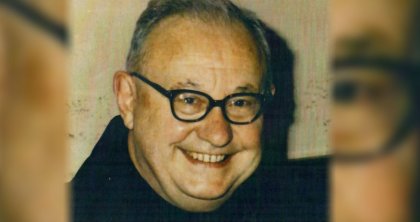
Carlo Zucchetti, was born in Vighignolo, a hamlet of Settimo Milanese (Ml), Italy, on November 29, 1914 at half past four in the morning, the second son of the four children of Giulio and Luigia Zucchetti. A simple family but with a clear Christian tradition; a few hours after his birth he was baptized in the parish church of Santa Maria Nascente.
Very early the child felt in his heart a vocation to the priesthood. On the advice of the parish priest he decided to enter the vocational college of the Discalced Carmelites in Monza; after completing his high school studies, in 1930, Charles asked to enter the Order of Carmel.
On July 11, 1930, at the Concesa Monastery of Milan, in the Shrine of the Divine Motherhood, Charles put on the habit of the Order of the Blessed Virgin Mary of Mount Carmel and was given the new name of Brother Marcellus of Mary Immaculate. His novitiate now began. On July 17, 1931, he made his first profession. After high school and philosophical studies in Milan, Brother Marcellus continued his theological studies in Piacenza. On 8 December 1935 he made his solemn profession. On 11th of June 1938 he was ordained a priest.
After two short stays in Turin and Parma, he was transferred to Bologna where he remained for ten years. In 1948 he was sent to Ferrara to the St Jerome monastery: for thirty-six years the city experienced the incessant charitable service of Father Marcellus, especially as confessor and spiritual director. From 1951 to 1957 he held the position of Prior of the monastery. In 1960 he became Chaplain of the Paediatric Division of the St Anne General Hospital.
He died on July 13, 1984.
The Diocesan Inquiry into his «life, virtue and reputation for holiness» was opened in the Ferrara diocese on 8th of December 2014 and closed on 25th of September 2021.
Procedure Lelia Cossidente
1. The canonical norms concerning the procedure to be followed in the Causes of Saints are stated in the Apostolic Constitution Divinus Perfectionis Magister promulgated by John Paul II on 25 January 1983 (AAS LXXV, 1983, 349-355).
2. To initiate a Cause it is necessary that at least five years pass after the death of the candidate. This is to allow for greater balance and objectivity in the evaluation of the case and to allow the emotions of the moment to decant. There must be a clear conviction among people about his/her sanctity (fama sanctitas) and about the efficacy of his/her intercession with the Lord (fama signorum).
Links - Lelia Cossidente
Documentation [Lelia Cossidente]
![Documentation [Lelia Cossidente]](/media/k2/items/cache/f59e5e3530c2c45e61d5a0c945f954cb_Generic.jpg)
PLEASE NOTE
1) In order to be able to consult the Positio please fill in the request form on this page.
2) If your request is accepted, we will then send you the conditions and directions for consulting the document.
[No form id or name provided!]
Lelia Cossidente
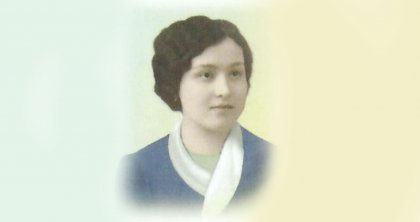
Lelia Cossidente was born in Potenza on the 4th of May, 1893.
She followed the family who moved to Rome in 1904. In 1913 she obtained her normal license, taught in an elementary school in the San Lorenzo district, worked as a cashier in a bank and finally, for ten years, was employed in the library of the State Magisterium of Rome. She was a member of the Sacred Heart Parish which she attended assiduously, as well as the "Caterina Volpicelli" Institute, where she spent her free time in the embroidery and sewing workshop.
On 29th of September 1930, she married Ulisse Amendolagine in the Parish of Saint Teresa. She then became part of the confraternity of the Holy Scapular (Our Lady of Mt Carmel).
Open with a love for life, they become parents of five children, for whom all their attention went into education and formation, especially religious. For this reason they would choose Catholic schools and collaborate, through a continuous dialogue with teachers, in the moral, spiritual and human growth of their children. Teachers and professors, male and female religious, were also be a valid help for their Christian maturity, as well as for the management of the family. They followed their children at school (Brothers of the Christian Schools, Marist Brothers, Sisters of St. Frances Cabrini and St. Angela Merici) and in their free time (at the Discalced Carmelite Fathers of the Parish of St. Teresa), taking part in their activities in continuous dialogue with educators, for whom they always showed great trust and respect.
The war put a strain on the whole family: bombings, the escape from Rome as displaced persons to a village in Abruzzo (Cappadocia), retirement from office during the German occupation, seeking refuge and hiding in the Roman Major Seminary, the fear of German roundups and retaliation, but above all the lack of the necessities to survive, did not discourage the two spouses who doubled their trust in Divine Providence. Prayer became effective and sometimes a miraculous support in the greatest of difficulties.
In addition to the Eucharist, for which a very special attention was nourished, family life took place under the loving gaze of Mary, who was daily invoked, so that she would «cover with her mantle» the parents and children. There was no shortage of other devotions that, going beyond simple prayer, were presented as examples to imitate (St. Joseph, St. Therese of the Child Jesus, St. John Bosco, St. Teresa of Avila, St. Jude Thaddeus ...). Illnesses, the daily bread of every family, were accepted not with resignation, but with serenity, always certain of the benevolent hand of God who guides every event for our good.
Lelia, accompanied by the heart felt pain for the whole family, climbed Calvary quickly. Almost two years of atrocious suffering, from a tumour of the mesentery, she died on July 3rd, 1951. In the last days we heard her constantly murmuring the last part of the Hail Mary: «Now and at the hour of our death.»
The Diocesan Inquiry into her «Life, Virtue and Reputation for Holiness» was opened on 18th of June 2004 and closed on 24th of May 2011 in the Diocese of Rome.
Procedure Cunegonda Siwiec
1. The canonical norms concerning the procedure to be followed in the Causes of Saints are stated in the Apostolic Constitution Divinus Perfectionis Magister promulgated by John Paul II on 25 January 1983 (AAS LXXV, 1983, 349-355).
2. To initiate a Cause it is necessary that at least five years pass after the death of the candidate. This is to allow for greater balance and objectivity in the evaluation of the case and to allow the emotions of the moment to decant. There must be a clear conviction among people about his/her sanctity (fama sanctitas) and about the efficacy of his/her intercession with the Lord (fama signorum).
Last News

Venerable Jean-Thierry of the Child Jesus and the …
June 17, 2026

Venerable Maria Eletta di Gesù
June 17, 2026

Venerable Maria Teresa of the Most Holy Trinity (Y…
June 17, 2026

Blessed Anna of Saint Bartholomew
June 10, 2026

Martyrs of Santander
May 27, 2026
